
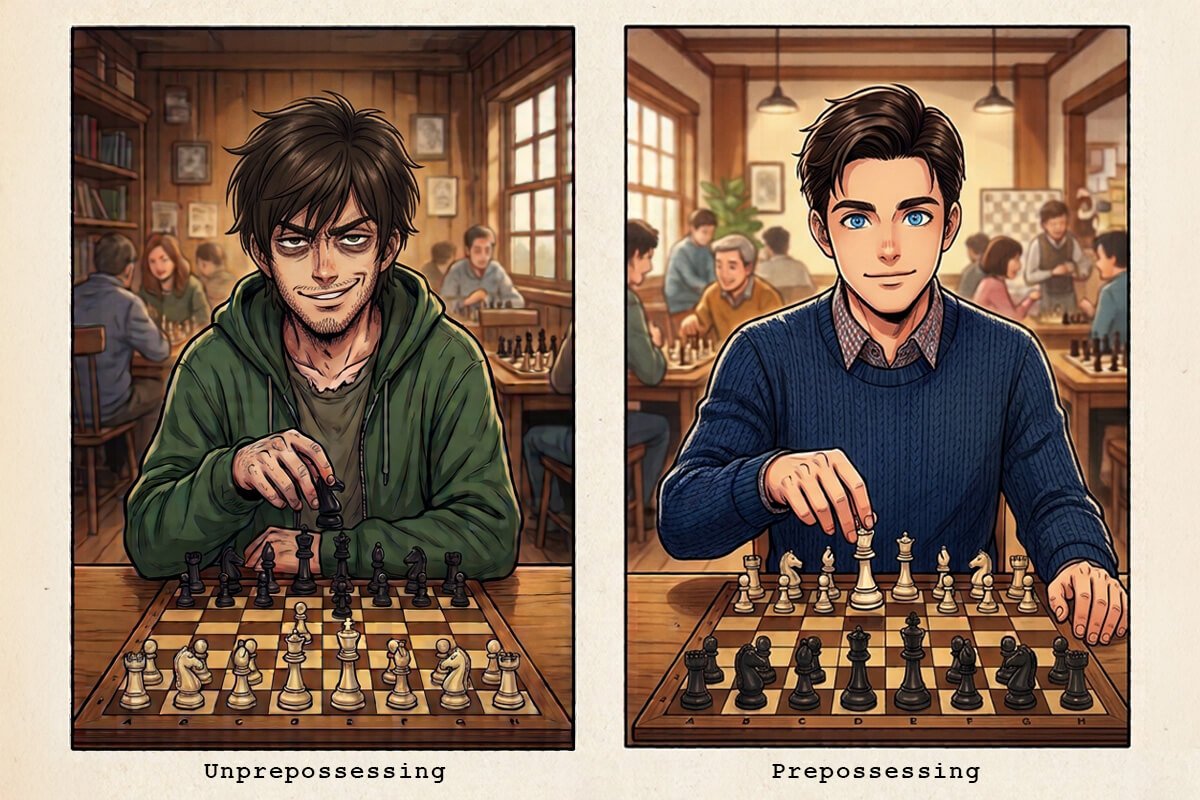
Now here was a head-scratcher. What did he mean?
It was circa 1982, during my tenure as editor of Chess Life magazine. I was working my way through a pile of manuscripts for the next issue. In front of me: a neatly typed, double-spaced submission from Rick Knight, a glowing profile of a Southern California Grandmaster. In the first paragraph, he wrote: “Larry Bishop is imbued with an unprepossessing brand of confidence.” Hmm. It didn’t feel right.
I reached for my constant companion, Merriam Webster (circa 1983 means: no Internet, no Google). Looked up “unprepossessing.” Yeah, that doesn’t land the way I think Rick intends.
Unprepossessing: not tending to create a favorable impression
Now, deeper down in the explanation, MW also indicated it might be employed to suggest that, though the first impression may be unfavorable, it hints at hidden qualities.
Nah, that still didn’t match the exuberance with which Rick was heaping praise on GM Larry.
I changed it to “prepossessing” and continued my edit.
Out of an abundance of unnecessary caution, I’ve obfuscated the names. “Larry” was a pre-eminent U.S. player, then ranked among the world’s top GMs. “Rick” was a journalist well known in chess circles, who contributed occasional tournament reports and human-interest profiles. His prose was consistently fine, and occasionally even elegant. He could be a bit prickly about his work, but given his overall facility with words I didn’t mind going light with the editing pen to stay on his good side.
As I worked my way through the rest of the manuscripts, though, the first sentence was not the only adjustment. So I anticipated a bit of negotiation in our sign-off conversation. A few days later, photocopies of the typeset galleys were in the mail to Rick for review and approval. (Remember: no Internet, no email.)
I Crossed My Fingers
A few days later, my desk phone buzzed, and our office operator informed me Rick was on the line. (Remember: no phone trees, no individual voicemail.) I answered. No hello from Rick, no how ya doing. I can’t quote our conversation with fidelity, but I’ll paraphrase to the best of my memory. His opening line: “You’ve absolutely ruined my article!”
Even as a fledgling editor, I’d learned that an even, composed reply kept conversations from spinning down unproductive paths. “Well,” I said, “that’s why we send galleys for review. Where do we start?” I felt I knew where this might be going, but it was best to let him lead the way. “You’ve completely ruined the entire article. I wrote that Larry has an unprepossessing brand of confidence, and you changed it to prepossessing!”
I’m all calmness. “Hmmm … I think that’s one of those frequently confusing words, but let me check.” I slid the ever-present Merriam Webster close to the phone so he can hear me riffling through the pages. “Yeah, here it is.” And I read the definition that I had consulted a week or so ago. Silence. Then: “Well, I guess you saved me there.”
Now, there’s several ways you can play this. Chastise the writer for not doublechecking. Gloat. Feign umbrage at having your time wasted.
Not helpful.
I plowed ahead quickly to let him know I had no intention of holding it over his head. “It’s commonly misunderstood. I put it down to real estate agents who use it as a weasel word to soften the description of an unappealing property. It’s so frequently slyly used this way that a lot of people read it the same way you did.” Or soothing words to that effect.
I took a breath and said, “OK, what’s next?” And by now I absolutely knew what was coming next. “Well, I haven’t read the rest of the article. I was so upset I got on the phone the minute I read it.” Again, I didn’t play-act at hurt feelings. I let him know we were only a few days from copy deadline, so once he had a chance to read the piece through, he should call immediately with corrections.
And that was the last I heard of it. No follow-up call. Copy deadline passed. Presses rolled.
And the article ran. No letters to the editor about the article. No curious enquiries. Nada.
So, All’s Well that Ends Well?
Yes … and no. I’ve been second-guessing that interaction for the past 40 years. I was right, but I was wrong.
I’d forgotten the basics. Knowing that Rick could be a bit defensive of his prose, I’d chosen the “path of least (editing) resistance,” so to speak. “Prepossessing” was the right definition, but the wrong choice. I’ll speculate that Chess Life readers were (and still are), on average, better read and educated than, say, perusers of The National Enquirer. Still, they ranged from eight-year-old beginners to adults who grew up reading something other than English. If a careful wordsmith like Rick could misunderstand “unprepossessing,” was “prepossessing” any better? If I’d substituted something like “unpretentious” it would have come closer to Rick’s intent. Or to stretch toward the elegant: “confident but not cocky.”
One thing we all learn as writers, and have pounded into us as editors, is that we serve the reader first. I was trying to play it safe to avoid pricking a touchy writer’s tender ego. Now, yes, I’ll admit … this whole recollection is really minor, the proverbial tempest in a teapot, I suppose; the world kept spinning. But as we wield the pen (now, the delete key), it’s worth remembering, as our cursor hovers over a target word, to remember who we’re editing for.